
Your cart
There are no more items in your cart
Higonokami knives, a story of performance
-
Categories:
Knives
This small piece of metal forged with the same finesse as a samurai sword is an iconic knife of Japanese culture. Its disconcerting simplicity and finely sharpened blade are the perfect combo to make it a formidable weapon. Popularized on the international market towards the end of the 19th century, its history goes back more than a hundred years. Even today, it is considered the quintessential all-purpose knife. But what are the characteristics that set these Japanese pocket knives apart? Let's focus on that.
The Higonokami, the samurai icon
The Higonokami, behind its simplistic appearance, hides a weapon that marked Japan towards the end of the 1800s. It was invented in 1896 during the industrial revolution, at a time when samurai were banned. Sword makers thus decided to make Higonokami knives. Very quickly, these tools became indispensable in the daily lives of Japanese people. This type of pocket knife owes its name to the contraction of the words Higo no Kami, literally meaning: Lord of Higo. This title was honorific to the samurai of the Higo region in Japan.
Long after their invention, Higonokami knives were very popular among Japanese schoolchildren. They were not only used in the culinary field, but also proved useful for performing complex tasks. Over the years, they have been somewhat overtaken by the enthusiasm for survival knives, multi-function knives, or even karambits. But the passion of collectors has allowed manufacturers to give new life to these knives. Although they no longer have their former popularity, they remain just as trendy.
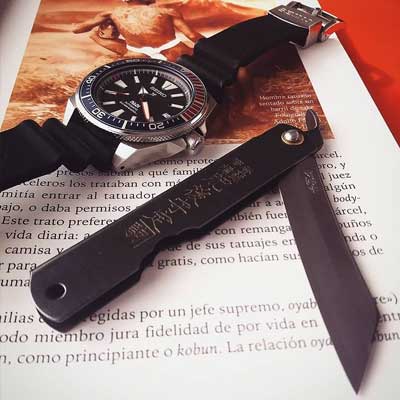
Decoding the configuration of a Higonokami knife
In its overall design, the Higonokami features a rather classic design. Like standard knives, it incorporates a blade and a handle. The blade, in its original design, was composed of three layers of steel. The first layer was quite hard and remained placed between two other softer layers. This design contributed to making the knife more resistant. The blade of today's Higonokami knives enjoys the same configuration, but brands have made sure to add a more "innovative" touch. Now, it is made with a carbon steel core combining elegance, robustness, and durability.
As for the handle, a simple piece of hammered brass was used to make it. The signature of the blacksmith who designed the knife and the silhouette of the famous samurai Miyamoto Musashi were engraved on it. On the new models that have been launched quite recently on the market, we still find this same design. The only difference is that they no longer have signatures except for certain brands.
The characteristics of Higonokami knives
The blade is certainly the main feature that distinguishes Higonokami knives. It is not only renowned for its finely sharpened edge. It is especially appreciated for its design similar to that of a katana.
Versatility is also a key criterion that differentiates the Higonokami knife from a standard knife. Apart from being a great help in preparing culinary recipes, its folding design also gives it great practicality for occasional uses.
In terms of maintenance, it requires little attention. Occasional sharpening is necessary just to keep the blade's sharp aspect.