
Your cart
There are no more items in your cart
Japanese Knives or European Knives?
-
Categories:
Knives
Japanese and European cultures are very different. This also explains why the culinary techniques of the two continents are not similar. Consequently, the knives used in Japanese and French gastronomic preparation differ on many points. It's important to know that each of these models has its own advantages and disadvantages. The choice will also depend on many criteria. Let's take stock.
The blade: from the steel used to the sharpening angle
Japanese knives, compared to European knives, are known for their long, sharp, and finely crafted blades. This reputation is undeniable, given that most models from Japanese manufacturing enjoy artisanal craftsmanship. At the same time, the blade of Japanese knives is often made from very hard steel (58 to 66 Rockwell degrees). This makes these models less flexible and therefore more fragile when in contact with hard foods. European knives, on the other hand, have a blade with a hardness of around 54 Rockwell degrees.
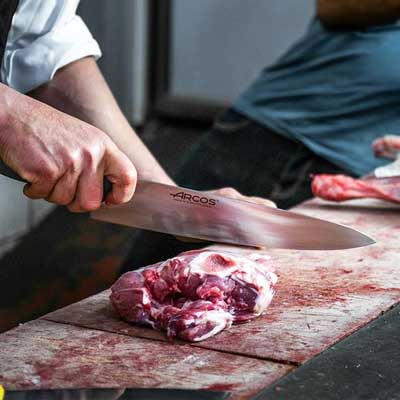
In terms of thickness, European knives have a thicker blade with a more robust edge. This explains why they are more versatile and can cut through bone without breaking. Japanese knives, on the other hand, have a thinner blade. This characteristic is common to the vast majority of models. That's why they are more often used for slicing large pieces of meat or fish fillets into thin slices.
Regarding the sharpening angle, Japanese knives are more complex to sharpen. They have a sharpening angle of 15° for a bilateral edge. For European knives, this angle will be 20° on average.
The handle
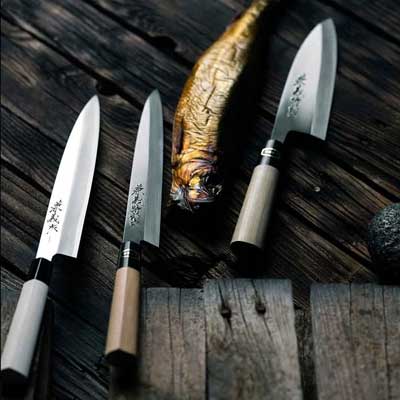
Wood is the material most often used for making the handles of Japanese knives. Noble par excellence, wood gives each model a more attractive and designer aesthetic appearance. However, it remains fragile and requires specific treatment. On the other hand, for European knives, the handle is often made of plastic, POM, or suede. These materials, combining strength and durability, also require no special maintenance.
The verdict?
The choice is yours! Japanese kitchen knives, due to the finesse of their configuration, are considered true masterpieces. Their razor-sharp blade allows for precise cutting, whether it's meat, fish, or vegetables. The models are also varied to meet different uses.
European knives, on the other hand, reflect robustness at its highest level. From the handle to the tip of the blade, they benefit from a measured design. The materials used in their overall design are also of premium classification. This explains why they are the most appreciated for cutting and deboning meat carcasses.