
Your cart
There are no more items in your cart
Japanese knives: what are the different types of models?
-
Categories:
Knives
In the process of shaping their blade, different layers of steel are used to give them more solidity. Precise gestures are also performed to form the inflections of the curves as well as the subtle bevels of each model. The handle, meanwhile, is made from noble wood essence topped by a buffalo horn-shaped ring. All these parameters classify Japanese knives as the most popular models among professional restaurateurs. Especially since there are numerous variations to meet all needs.
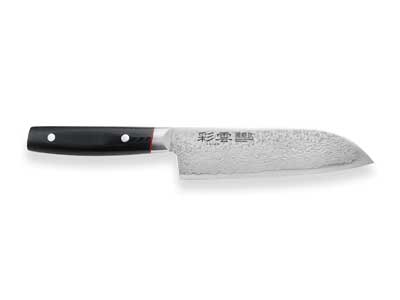
The Santoku
The Santoku knife is certainly the most common model of the entire range. In the literal sense of the term, Santoku means "three good things, which could be translated as: slicing, dicing, and chopping. Precision and efficiency are the key words that characterize this type of knife. With its slightly curved blade, it is able to perfectly chop herbs that will serve to give a delicious taste to your recipes. At the same time, it can be as effective as a cleaver for cutting meat.
The Deba
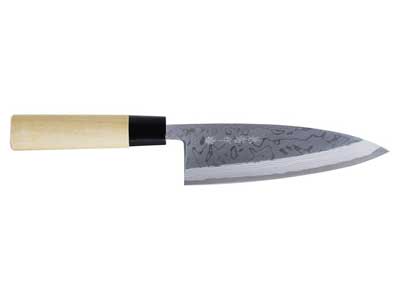
The Debahocho is a Japanese knife that was invented in the year 1700 in Sakai. Featuring a design that combines both cleaver and chef's knife, the Debahocho is characterized by a sharp, wide, and sharpened blade. This gives it unparalleled efficiency for filleting fish without damaging it. It can also be used for cutting and deboning.
The Sashimi
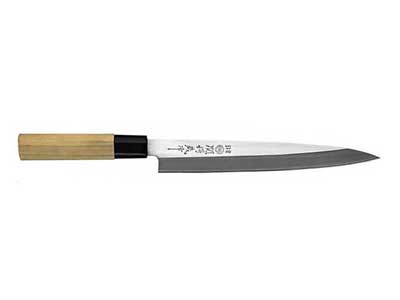
Known as a sushi knife, the sashimi is characterized by a long and inflexible blade. Sharp with a single edge, it is the most used by restaurant professionals for removing fish skin. Sea bream, salmon, flatfish, it makes no exception. As for sushi, the rigidity of its blade allows it to ensure a precise cut so that each bite is identical.
The Gyuto
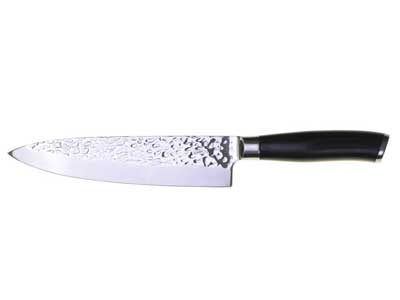
The ultimate Japanese chef's knife, the Gyuto is also called a beef knife. With its flat blade with a 22° edge, it ensures precise cutting of meat and can be used to slice vegetables or herbs.
The Nakiri
Because vegetable preparation requires a tool that can combine sturdiness and lightness, the nakiri is meant to be the best choice. Often confused with the Usuba, the Nakiri enjoys a more refined and compact design at the same time. Due to its configuration, it is suitable for cutting all kinds of vegetables, but can also be used to knead condiments.
The Honesuki
The Honesuki knife is a boning knife with a triangular shape. Its sharp blade with an asymmetrical edge is able to debone poultry or a meat carcass without breaking. And while single-edged models are the most popular, there are variants with two sharpened edges that are just as effective.
The Sujihiki
If you tend to cut large pieces of meat, the Sujihiki is the perfect knife. Also known as a "lard slicer, it is characterized by a long, smooth, and thick blade, capable of slicing any meat and fish in a single pass.